
When we first started selling WordPress premium themes in 2009 it was industry best-practice to offer “lifetime” support and updates. At the time everyone selling WordPress themes was offering unlimited support requests and updates and we were happy to do the same.
All was well for a couple of years, but eventually questions about sustainability started: if you purchased a WordPress theme once for $60, is it a fair deal to both parties to offer unlimited support requests and significant updates for years to come? As popular themes started receiving huge updates years after their original release, questions about sustainability started arising.
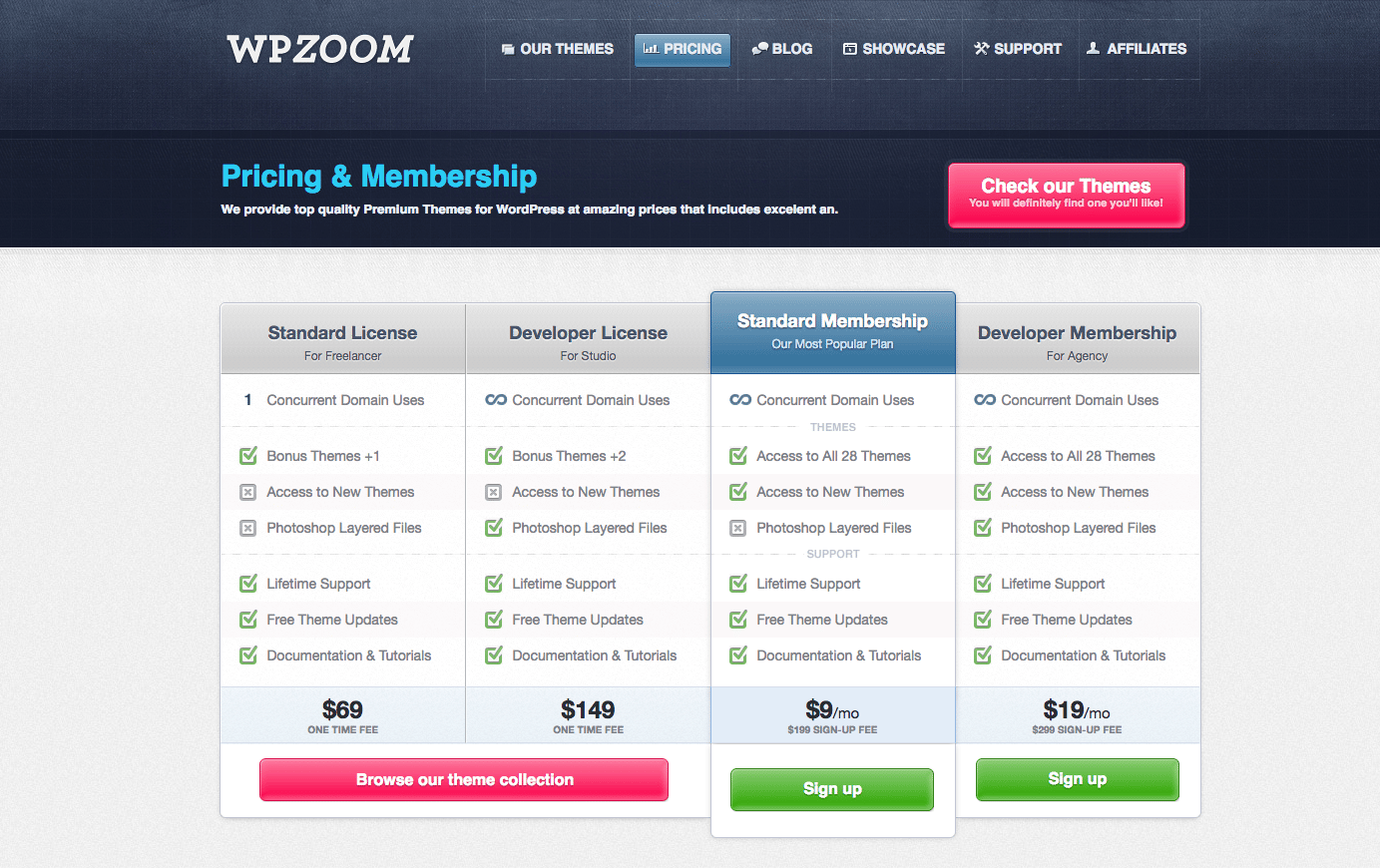
WooThemes made the first significant move, ditching their unlimited model in favour of one year of support and updates with each purchase. At the time, WooThemes provoked outrage by invoking their right to unilaterally change their terms and conditions and make the change for all customers. This was quickly changed to an option to opt out of the change in terms, but arguably this was an attempt to damage limitation.
Despite the negative reaction to WooThemes’ move, the business argument made sense. Unlimited support and updates could have put theme companies out of business in the long run, or at least vastly increased costs and limited their capacity to innovate. In the months and years following, most themes companies – including us – copied the move. Notably, Woo’s attempt to migrate existing customers to the new licence offered a valuable learning point and most companies (also including us) recognised the importance of making the licence change only for new customers.
Skip forward a couple of years, and the debate has now moved on from whether to charge for annual licence renewals to whether to automatically charge for annual license renewals. Syed and Pippin have led the public charge on this. Here are Syed’s comments:
Until recently, every WordPress plugin relied on voluntary subscription renewal. A lot of plugin authors offered renewal discounts to encourage users to renew the plugin. After seeing the success from OptinMonster SaaS, we decided to challenge the status-quo and converted all of our WordPress plugins to recurring billing.
Pippin’s comments come after nearly a full year of enabling automatic updates across his company’s plugins:
Since enabling subscriptions, we have not seen any drop in sales volumes… The fear I repeatedly hear from business owners is that turning on subscriptions will cause sales to take a dive off a cliff. This is simply not something we have seen, nor something I’ve heard from a single business owner that has followed suit in transition to subscription models.
Pippin then followed up these comments in a recent blog post:
When combining the increase in revenue with the decrease in support burdens, this price change has so far appeared to be incredibly positive for us. It is a single move that might just be one of the most important changes we have ever made.
Automatic updates are in, and extra revenue they generate is clearly very attractive – so what’s the problem?
How often are customers actually changing WordPress themes?
Let’s back up for a minute: the markets for plugins and themes are obviously different, and a key difference is a change in customers’ propensity to change WordPress theme. You can have as many plugins as you like – and each plugin you pay for may only compete with a couple of other plugins – but you can only have one theme, and all themes compete against all other themes.
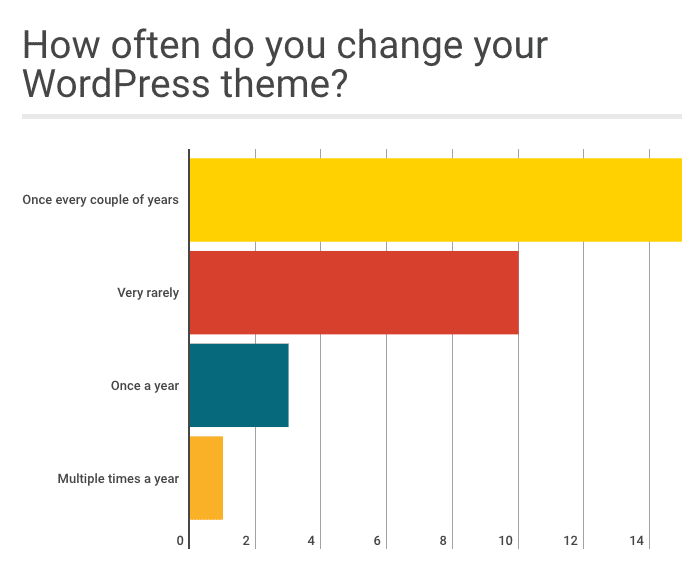
We wanted some data, so we surveyed the wider WordPress community to find out people’s approaches to WordPress themes and how often they switch. The results showed most people don’t change their WordPress theme very often. Take a look:
We also asked in the (smaller) WPZOOM users Facebook group and had a similar distribution of responses:
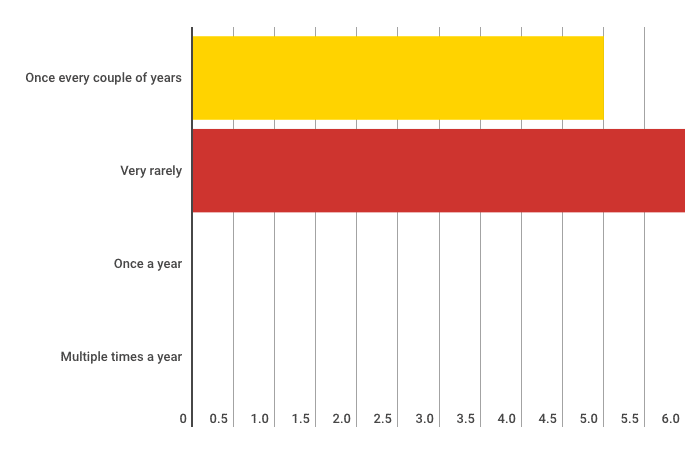
It looks like most people periodically choose a WordPress theme they like and then stick with it for a couple of years.
If people are sticking with the same theme for a couple of years, what’s the best way to deal with renewals? Is this an insurmountable difference between plugins and themes? Should you bill automatically?
Here’s why we’re not doing automatic renewals
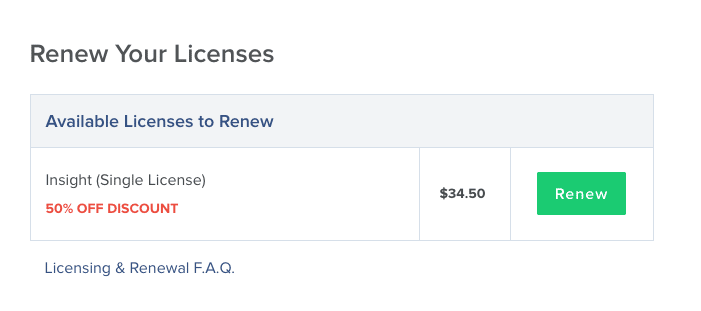
Despite the movement towards this, we’re not doing automatic renewals. Each theme purchase comes with one year of support and updates; after this period customers can purchase an additional year of support and updates with a 50% discount.
This reflects the state of the theme market, versus the plugin market where ongoing value is easier to provide (it’s much easier to provide significant updates to one plugin than 30+ themes) and competition is less intense.
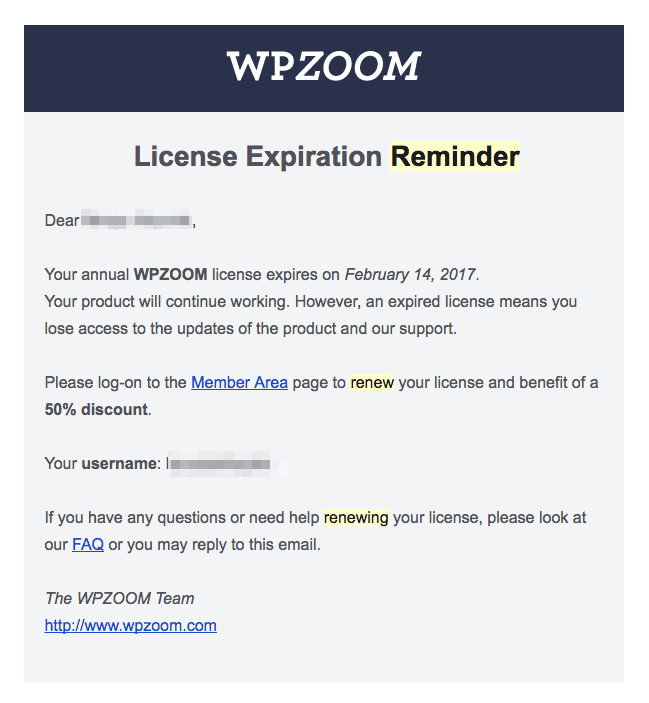
Customers are informed by email when their license is about to expire and then again after it has expired:
Renewal is easy and can be done from our Member Area:
If a customer doesn’t want to renew their license that’s their prerogative, and they’re free to continue using the theme. Sure we miss out on revenue by not automatically renewing, but we know we’re giving customers freedom and putting the onus on us to actively keep providing value to customers.
Here’s some data:
In 2016 WPZOOM had an average renewal rate of 8.5%. For some niches this figure’s a lot higher:
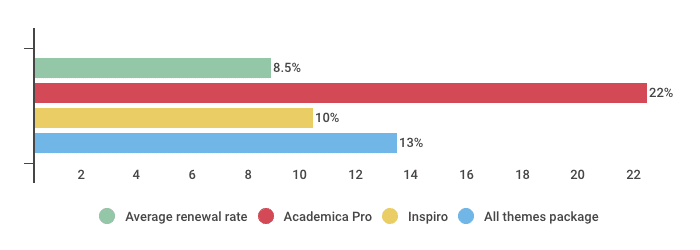
Education themes are an interesting example: Academica Pro and Capital have renewal rates around 20%. This possibly reflects education customers getting higher ongoing value from our services and being keen to get the latest updates for security. Equally, our All Themes Package enjoys higher-than-average renewals because of its ongoing value: whilst your license is active you get all the new themes we release.
On the other side of the proverbial coin, our portfolio WordPress themes (such as Inspiro) are loved by customers but have a low renewal rate. The best guess on this is the creatives using our portfolio themes are too busy creating beautiful work and don’t spend much time updating their websites.
Our renewal rate looks similar to our industry peers using manual renewal and that’s okay. It’d be a lot higher with automatic renewals, but we wouldn’t be giving customers the freedom to choose.
Conclusion
The takeaway here is our customers generally aren’t renewing their licenses. The data on this suggests customers are happy to stick with a theme for 2-3 years and then they’ll switch, so our focus needs to be on providing ongoing value during the period a customer has a theme with us.
Automatic renewals may work for plugins and could work for themes, but we don’t think they’re the right choice for our customers right now.
Could we do a better job communicating the importance of updating your WordPress theme and the new features we’re adding to themes? Quite probably, and we’ll be looking at ways to do this.
We don’t think, however, that automatic updates are the best way of addressing the issue.

March 23, 2017 5:21 pm
You could be a trendsetter and offer 2-year licenses instead of 1-year. Now, the value of your license is higher to the consumer, which may increase sales. At the end of the 2 year period, it would be a perfect time to let the user know that people who love “their theme” also love the latest themes you’ve created. They’ll be in the mood to change themes at that point anyway. Just a thought. :)
March 27, 2017 9:35 am
Something to think about, for sure :) I’m aware of one or two theme shops offering two-year licenses – would need some careful analysis to work out if it was right for us.
March 28, 2017 10:06 am
Obviously, I understand the business standpoint and it makes no sense to give unlimited support for free. I just think that 1 year is a relatively short period given that WordPress is constantly being updated and that might prevent the theme from working correctly.
From the client standpoint, it’s frustrating to know that after just 1 year, the theme might not work as it was meant to be.
April 4, 2017 6:07 pm
Hi Ana, while 1 year may or may not be a relatively short period of time, you also need to take into account the small price you’re paying for a WordPress theme.
Single theme licenses for premium WordPress themes usually are available within a range between $39-$69. And especially because WordPress is constantly being updated, developers need to maintain, update and support their products on a regular basis and these costs need to get covered somehow.
Paying a few bucks once a year for your WordPress theme that is constantly being updated and which makes your site appear as you like shouldn’t be a big deal. Especially not when you consider that behind the scenes people are working hard to provide great products for the cost of a restaurant visit. ;-)
August 28, 2017 7:16 pm
I agree with you Ana. If you think that sometimes we pay a medium price for a theme/plugin and it can stop working in just 12 months… This isn’t so funny.
But well, I understand that some clients make support team spent to much time with easy questions that even my children can answer.
We need to think in the 2 sides of the coin.
April 2, 2017 5:52 am
Marvellous idea and interesting blog article.
June 6, 2017 11:30 am
I did not know about this information. I always try automatic upgrade.
August 30, 2017 3:49 pm
I believe this is the best form of billing. Even if the support for a theme is reasonably little, you have a job and each update is theoretically a new theme with new features. More than fair.