Estimated reading time: 13 minutes
WordPress powers 40.1% of all websites in October 2026, making it the most widely used content management system in the world. What started as a basic blogging tool in 2003 now serves as the backbone for everything from personal blogs to enterprise platforms used by some of the biggest brands on the planet.

These WordPress statistics cover the full picture: market share, growth trends, themes, plugins, eCommerce, security, and more. Whether you’re evaluating WordPress for a new project or just curious about where the platform stands today, the data tells a compelling story.
Quick Facts: WordPress Statistics in October 2026
- WordPress powers 40.1% of all websites globally.
- WordPress holds a 58.6% share of the CMS market.
- There are over 30,000 WordPress themes available.
- More than 74,000 free plugins in the WordPress.org directory.
- WooCommerce holds a 29.1% share of the eCommerce market.
- WordPress has been translated into over 200 languages and locales.
- There have been 55 major WordPress releases since 2003.
- The top 10 countries account for over 26 million WordPress sites.
Table of contents
- What Percentage of Websites Use WordPress?
- How Many Websites Use WordPress?
- What Is the WordPress Market Share?
- WordPress Market Share: Year-by-Year Growth
- WordPress Usage by Country
- WordPress Version & Technical Statistics
- How Many WordPress Themes Are There?
- How Many WordPress Plugins Are There?
- What Percentage of Websites Use WooCommerce?
- FAQ
- Sources & Methodology
- Final Thoughts
What Percentage of Websites Use WordPress?
As of October 2026, 40.1% of all websites globally use WordPress, according to W3Techs.
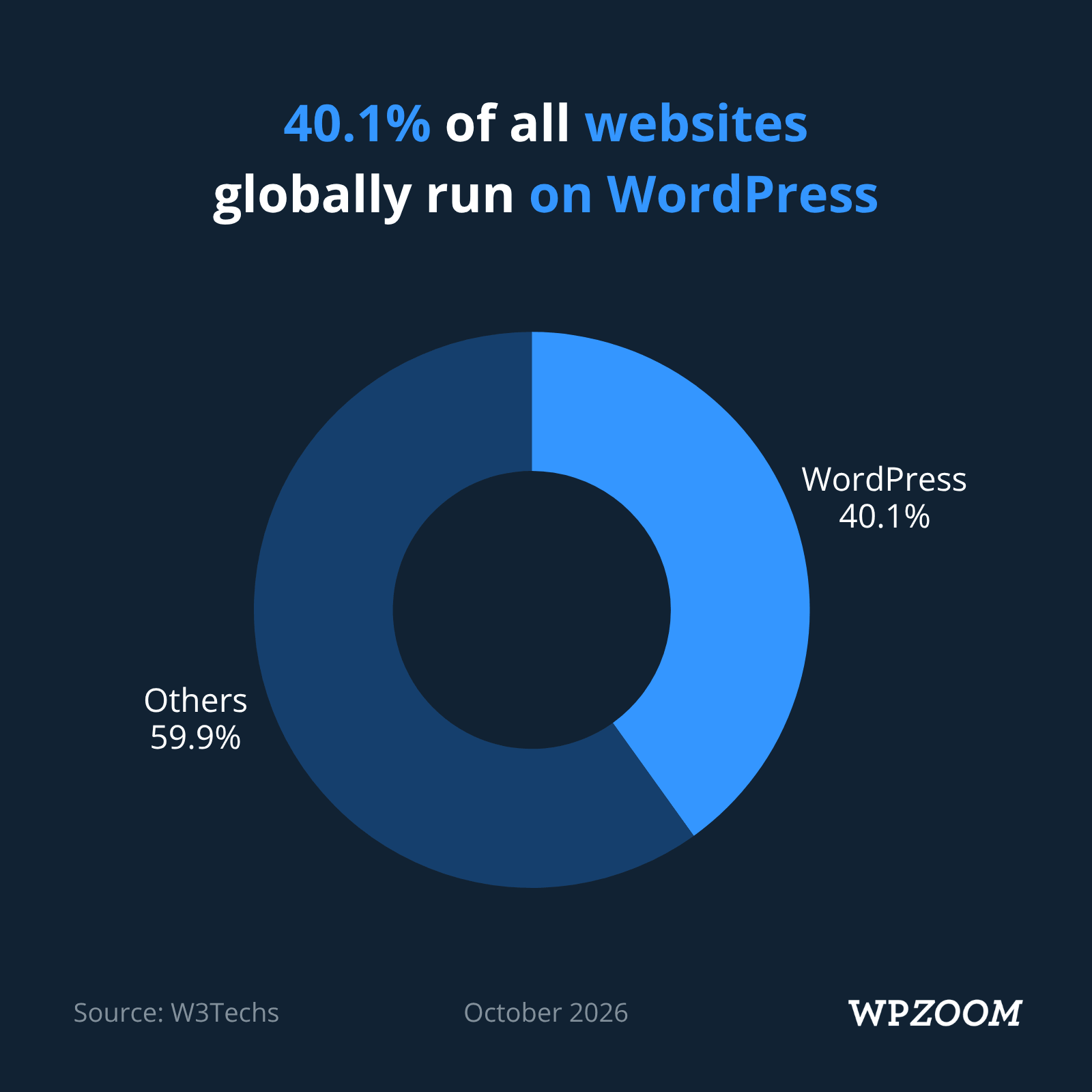
This figure represents WordPress’s share across the entire web, including websites that don’t use any content management system. W3Techs tracks technology usage across what it defines as “the relevant web,” focusing on sites with useful content and real traffic rather than parked domains or empty pages.
To put that 40.1% in perspective: the next closest platform is Shopify at 5.4%, followed by Wix at 4.2%. WordPress has more than seven times the market share of its nearest competitor.
Source: W3Techs
How Many Websites Use WordPress?
Roughly 37.3 million active websites run on WordPress, according to BuiltWith. Broader estimates reach as high as 599 million when every registered hostname is counted, but that upper figure is a theoretical ceiling, not a count of working sites.
The upper estimate is based on NetCraft’s July 2026 web survey, which counted 1.49 billion hostnames across the internet. Applying WordPress’s 40.1% market share (as reported by W3Techs) gives roughly 599 million. One caveat matters here: W3Techs measures that share across the top 10 million sites, so it doesn’t transfer cleanly to the full hostname population, which is why we treat 599 million as a ceiling rather than an estimate.
However, the exact number depends heavily on how you define a “website.” NetCraft counts all hostnames, including parked domains, staging sites, and domains with no active content. When looking strictly at active, functioning websites, the numbers are more specific. BuiltWith, which tracks technology usage across actively visited web properties, currently lists the number of live WordPress sites at roughly 37.3 million.
The real number of functioning WordPress websites sits much closer to the 37.3 million baseline than to the 599 million ceiling. Regardless of which metric you prefer, the conclusion is the same: WordPress runs on more websites than any other platform by a wide margin, even as its share has dipped slightly.
Sources: NetCraft, BuiltWith, W3Techs
What Is the WordPress Market Share?
Among websites that use a known content management system, WordPress holds a 58.6% market share, exceeding all other CMS platforms combined.
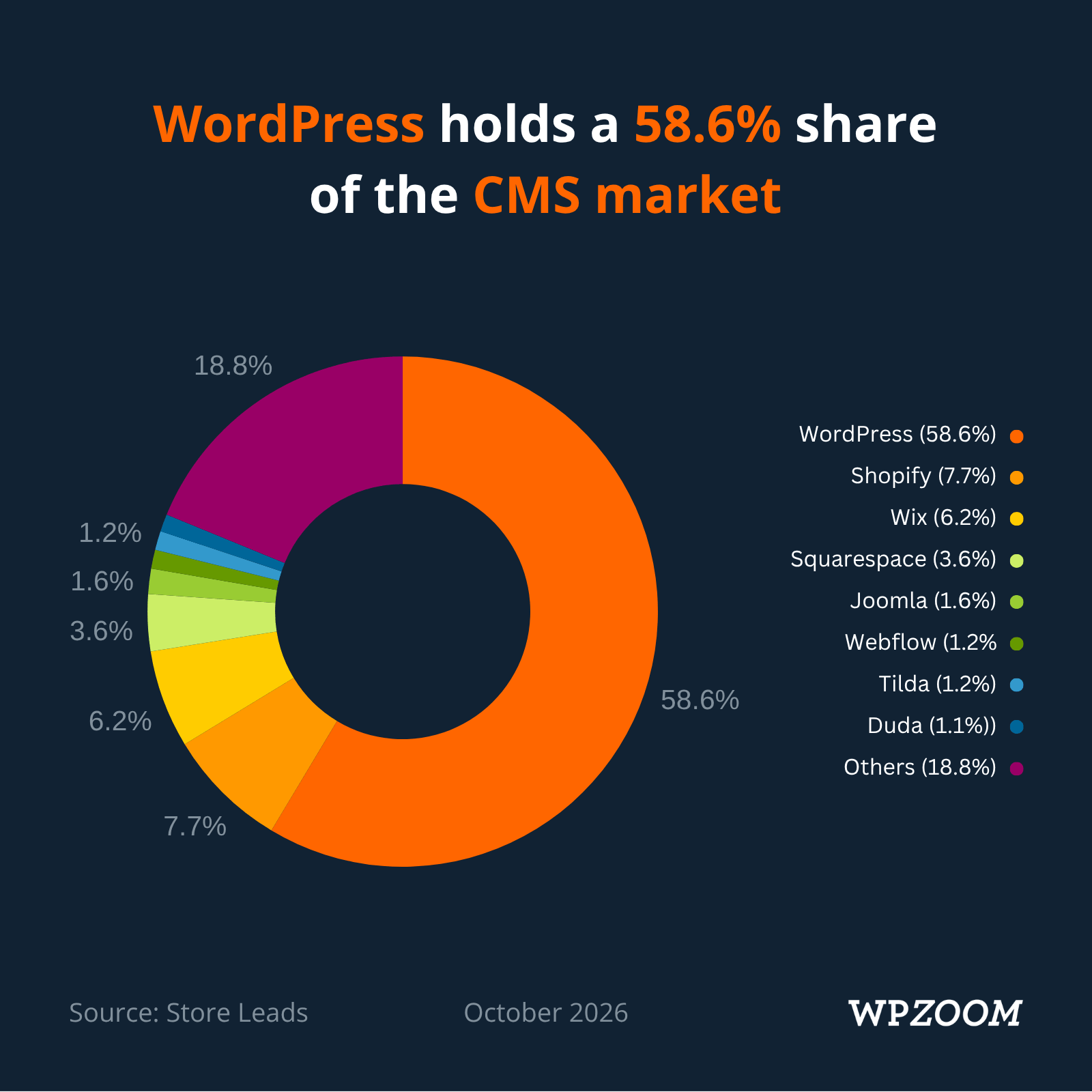
That dominance becomes even clearer when you compare it directly to the competition:
| CMS | Share of All Websites | Share of CMS Market |
|---|---|---|
| WordPress | 40.1% | 58.6% |
| Shopify | 5.4% | 7.8% |
| Wix | 4.2% | 6.2% |
| Squarespace | 2.4% | 3.6% |
| Joomla | 1.1% | 1.6% |
| Webflow | 0.8% | 1.2% |
| Tilda | 0.8% | 1.2% |
| Duda | 0.7% | 1.1% |
| Drupal | 0.6% | 0.9% |
| No CMS | 31.5% | — |
These numbers are corroborated by independent data. The HTTP Archive’s 2025 Web Almanac, which uses a completely different measurement methodology than W3Techs, found that CMS-driven sites now account for over 54% of all observed websites, with WordPress powering 64.3% of those CMS-driven sites on mobile. The difference comes down to how each source defines and samples websites, but both confirm the same conclusion: WordPress holds a commanding lead.
It’s also worth noting that 31.5% of websites still operate without a recognized CMS, either hand-coded or using custom solutions. But among the sites that do choose a CMS, WordPress’s lead is overwhelming. Shopify, its nearest rival in the CMS-only comparison, holds just 7.8%, less than one-seventh of WordPress’s share.
One stat that underscores WordPress’s enterprise reach: among the top 10,000 websites by traffic, WordPress accounts for roughly 51% of CMS usage. Platforms like Wix and Shopify are almost absent at this traffic level, while Drupal, with just 0.6% overall market share, holds 6-7% among the top 10,000, reflecting its strength with large institutional sites.
WordPress Market Share: Year-by-Year Growth
WordPress more than doubled its market share over the past decade, growing from 21% of all websites in 2014 to 40.1% in October 2026.
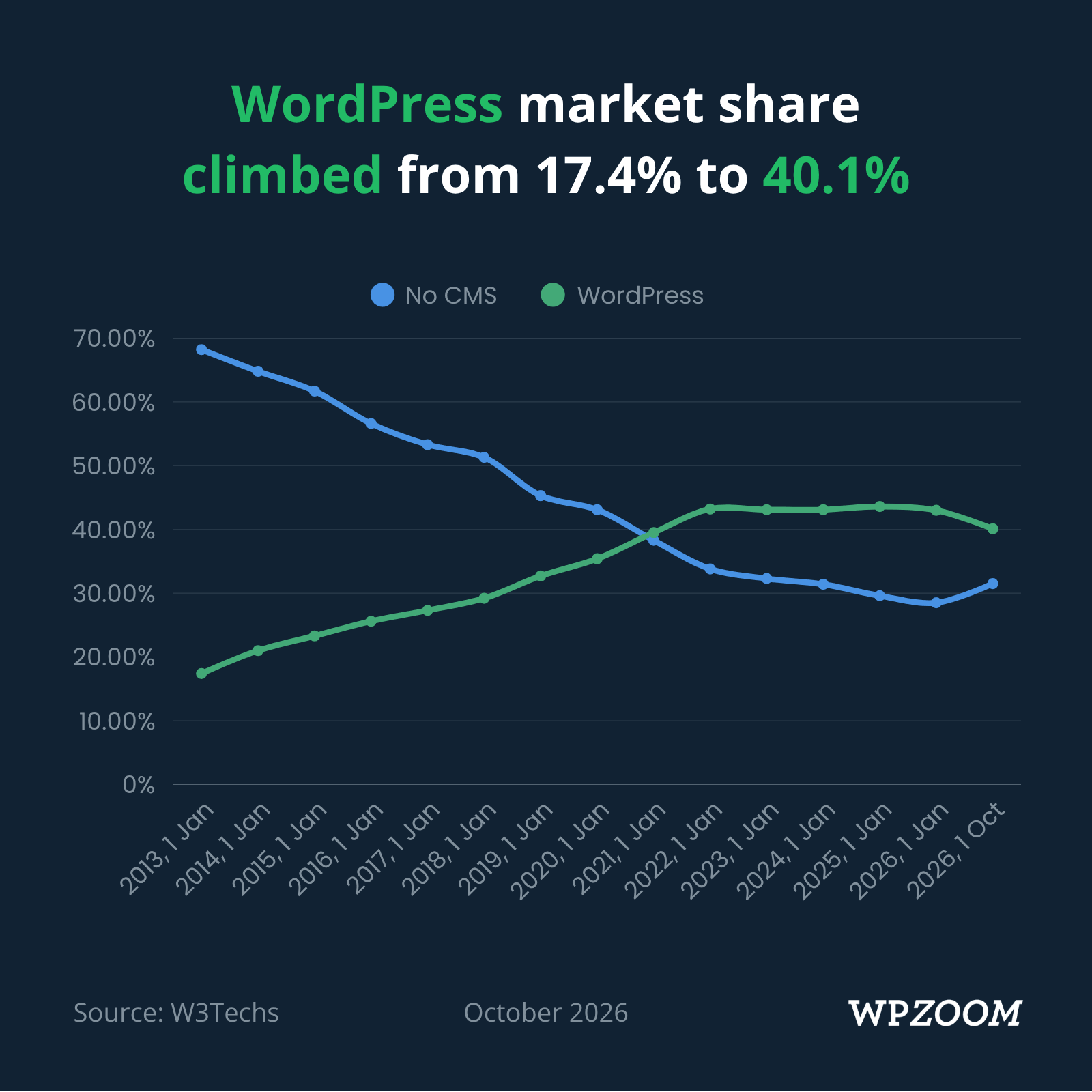
Here’s the full progression:
| Year | WordPress % of All Websites |
|---|---|
| 2011 | 13.1% |
| 2012 | 15.8% |
| 2013 | 17.4% |
| 2014 | 21.0% |
| 2015 | 23.3% |
| 2016 | 25.6% |
| 2017 | 27.3% |
| 2018 | 29.2% |
| 2019 | 32.7% |
| 2020 | 35.4% |
| 2021 | 39.5% |
| 2022 | 43.2% |
| 2023 | 43.1% |
| 2024 | 43.1% |
| 2025 | 43.6% |
| 2026 (Oct 5) | 40.1% |
Source: W3Techs Historical Overview. Numbers reflect January 1 of each year except 2026 (October 5).
A few things stand out from this data. WordPress grew at a pace of 2-4 percentage points per year between 2011 and 2022, crossing the 40% threshold in 2021. That same year marked another milestone: WordPress became more common than “no CMS”, the first time a single platform was used on more websites than the combined total of sites built without any CMS at all. Before 2021, hand-coding was still more common than any individual CMS. WordPress changed that.
Growth has leveled off since 2022: W3Techs’ January snapshots held between 43.1% and 43.6% from 2022 through 2025. Since then the share has slipped to 40.1% as of October 2026, the first sustained decline in the platform’s history. The HTTP Archive’s 2025 Web Almanac describes WordPress as shifting “from a focus on expansion to one on stabilization”, which points to a saturated market more than to one competitor taking WordPress’s place.
Meanwhile, the competitive landscape has shifted. Measured as a share of all websites, Shopify grew from well under 1% in 2014 to 5.4% today, Wix from 0.1% to 4.2%, and Squarespace to 2.4%. On the narrower basis of CMS market share, those figures are 7.8%, 6.2% and 3.6% respectively. Joomla and Drupal, once WordPress’s main rivals, have declined to 1.1% and 0.6% of all websites.
There’s also been a steady decrease in websites operating without any CMS at all, dropping from 68.2% in January 2013 to 31.5% in October 2026. The web has moved decisively toward content management systems, and WordPress has captured the lion’s share of that transition.
WordPress Usage by Country
The United States leads WordPress adoption with more than 16.8 million websites. Germany ranks second. The United Kingdom ranks third.
| Rank | Country | WordPress Sites |
|---|---|---|
| 1 | United States | ~16,800,000 |
| 2 | Germany | ~1,920,000 |
| 3 | United Kingdom | ~1,380,000 |
| 4 | France | ~977,000 |
| 5 | Brazil | ~963,000 |
| 6 | Italy | ~934,000 |
| 7 | Netherlands | ~873,000 |
| 8 | Spain | ~718,000 |
| 9 | Japan | ~716,000 |
| 10 | India | ~713,000 |
Source: BuiltWith. Figures for ranks 6-10 are approximate.
Japan is a particularly strong WordPress market. According to the State of the Word 2024, WordPress powers 58.5% of all Japanese websites and holds an 83% CMS market share in the country, significantly higher than the global average.
Google Trends data shows the highest relative search interest in WordPress from Pakistan, China, Bangladesh, Bosnia & Herzegovina, and Kenya, indicating growing adoption in emerging markets.
WordPress has been translated into over 200 languages and locales, and non-English installations now outnumber English ones. This global reach is one of the key factors behind WordPress’s continued growth.
Sources: BuiltWith, State of the Word 2024, WordPress.org Translations
WordPress Version & Technical Statistics
WordPress has released 55 major versions and more than 940 total versions since 2003. WordPress names each major release after a jazz musician. Version 1.0, “Miles,” honors Miles Davis.
Here’s how version adoption currently breaks down:
- Roughly 70.3% of WordPress sites run version 7.x
- Approximately 23.0% of WordPress sites run version 6.x
- About 5.1% still run version 5.x
- Approximately 1.6% run version 4.x or older
The rapid adoption of version 7, running on more than 70% of sites, reflects the WordPress community’s responsiveness to updates, helped by the release of WordPress 7.1 ‘Mary Lou’ on August 19, 2026. That said, roughly 6.8% of sites still run version 5 or earlier, some of which no longer receive security patches, which remains a concern for the ecosystem’s overall health.
WordPress Page Builder Usage
Approximately 59.1% of WordPress sites use a page builder. The breakdown among WordPress sites using a builder:
- Elementor — 43% of builder usage (down from 56% in 2024)
- WordPress Block Editor — 18% (growing, up from prior years)
- WPBakery — 13% (declining from 21% in 2024)
- Divi — 10% (declining from 14% in 2024)
- Beaver Builder — ~2% (stable)
The trend is clear: the WordPress ecosystem is gradually shifting from third-party page builders toward the native Block Editor, while Elementor remains the most widely used overall. (We maintain a directory of themes that support it.) Older builders like WPBakery and Divi are losing share as newer, block-native approaches gain adoption.
Sources: WordPress.org Stats, WordPress Release Archive, HTTP Archive’s 2025 Web Almanac
How Many WordPress Themes Are There?
As of October 2026, the WordPress.org theme directory contains over 15,000 free themes. ThemeForest provides more than 12,900 paid WordPress themes.
Together, these two sources account for over 27,900 themes. But that’s only the beginning; countless free and premium themes are available through independent theme shops like WPZOOM and others, significantly expanding the total selection. A conservative estimate puts the overall number of WordPress themes well above 30,000.
What Are the Most Popular WordPress Themes?
The most popular WordPress themes based on BuiltWith.com data from the top 1 million websites are Hello Elementor, Astra, Divi, GeneratePress, and Elegant Themes.
- Hello Elementor — 23,945 websites (12.48% share)
- Astra — 14,182 websites (7.39% share)
- Divi — 10,748 websites (5.6% share)
- GeneratePress — 10,604 websites (5.53% share)
- Elegant Themes — 6,968 websites (3.63% share)
On the Envato Market, the best-selling themes of all time are:
- Avada — 1.07M sales
- The7 — 337K sales
- BeTheme — 337K sales
- Enfold — 272K sales
- Flatsome — 270K sales
These numbers reflect the clear trend toward multipurpose themes and page builder-compatible designs.
Upgrade Your Website with a Premium WordPress Theme
Find a theme that you love and get a 20% discount at checkout with the FLASH20 code
Choose your theme
How Much Do WordPress Themes Cost?
WordPress theme costs range from free to more than $200. Premium WordPress themes typically cost $10 to $200+, with an average price of $59. Theme memberships cost $48 to $399 per year, averaging $145 annually. Lifetime memberships average $255 and provide permanent access without yearly renewal fees.
The cost of WordPress themes accommodates a wide range of budgets. Thousands of free themes are available for those just getting started, including our own free WordPress themes.
Source: WPShout (formerly CodeinWP), 2017 survey
How Many WordPress Plugins Are There?
The WordPress Plugin Directory contains over 74,000 free plugins. CodeCanyon offers more than 5,100 paid plugins. Together, these sources provide more than 79,000 WordPress plugins.
This number only scratches the surface. The broader WordPress ecosystem includes thousands of additional plugins sold through independent developers, SaaS companies, and niche marketplaces. The true total likely exceeds 80,000 plugins.
What Are the Most Popular WordPress Plugins?
The most popular WordPress plugins are Elementor, Yoast SEO, and Contact Form 7, each with more than 10 million active installations.
- Elementor — 10+ million active installations
- Yoast SEO — 10+ million
- Contact Form 7 — 10+ million
- Classic Editor — 8+ million
- WooCommerce — 7+ million
- LiteSpeed Cache — 7+ million
- Akismet — 5+ million
- WPForms — 5+ million
- All-in-One WP Migration — 5+ million
- Site Kit by Google — 5+ million
- Wordfence Security — 5+ million
The diversity of these top plugins, spanning page building, SEO, forms, eCommerce, caching, security, and analytics, illustrates the breadth of what WordPress can do out of the box with the right plugins.
Source: WordPress.org Plugin Directory
What Percentage of Websites Use WooCommerce?
WooCommerce powers 7.9% of all websites globally, making it the most widely used eCommerce platform. WooCommerce also powers 29.1% of all online stores worldwide. Its market share reflects strong adoption among businesses that use WordPress to build and manage eCommerce websites.
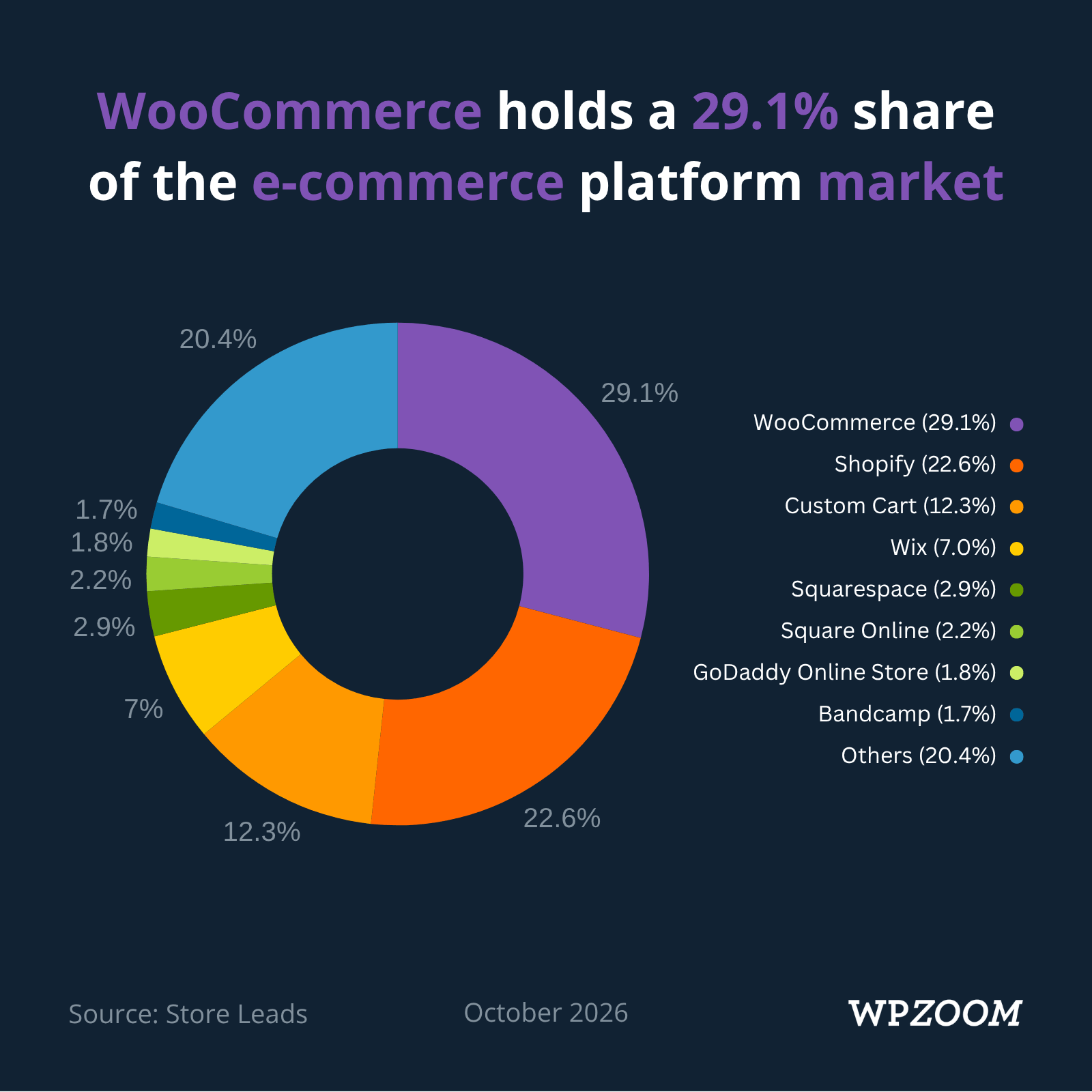
It outpaces its nearest competitors significantly: Shopify holds 22.6%, Custom Cart solutions account for 12.3%, and Wix holds 7.0%. WooCommerce’s position as an open-source, WordPress-native solution gives it a unique advantage in flexibility and cost. That flexibility starts with design: WooCommerce doesn’t lock a store into one storefront template, so owners pick a WooCommerce theme that fits their brand.
How Many Websites Use WooCommerce?
WooCommerce powers nearly 4.0 million live online stores worldwide, according to Store Leads, which tracks active WooCommerce installations directly rather than extrapolating from total hostname counts. That keeps WooCommerce ahead of Shopify’s roughly 3.1 million live stores, although the gap has been narrowing. As an open-source, self-hosted platform, WooCommerce’s real advantage is flexibility and cost rather than sheer volume.
Sources: Store Leads, W3Techs
FAQ
Yes, for most websites. It remains the most flexible, widely-supported CMS, powering 58.6% of all CMS-built sites with a vast theme, plugin, and developer ecosystem. The main alternatives (Wix, Squarespace, Shopify) trade flexibility for simplicity.
Common reasons include the convenience of all-in-one builders (Wix, Squarespace, Shopify), the rise of headless and AI-generated sites, maintenance and security upkeep, and uncertainty after the 2024 WordPress–WP Engine dispute. Overall market share has slipped from a 43.6% peak to about 40%, but WordPress still runs more sites than all other CMSs combined.
For general websites, its closest CMS competitors are Shopify and Wix, each with only single-digit market share. In ecommerce, WooCommerce competes most directly with Shopify.
Sources & Methodology
Last reviewed: (October 5, 2026) by Pavel Ciorici, founder of WPZOOM. We update this report every month to reflect the latest available data.
How we compile these statistics: CMS market-share percentages come from W3Techs, which surveys the top 10 million websites. Absolute counts come from BuiltWith (live WordPress sites) and Store Leads (live stores); the Netcraft-based figure is shown only as a theoretical ceiling. Ecosystem figures (plugins, themes, versions, locales) come from the official WordPress.org directories and State of the Word, and ecommerce data from Store Leads and BuiltWith. When sources report different figures, we cite the most recent and note its date inline.
A note on percentages: figures described as a share of all websites use W3Techs’ full survey base; figures described as CMS market share count only sites running a detected CMS. The two are not interchangeable, WordPress is 40.1% on the first basis and 58.6% on the second. Absolute site counts derived from these percentages are estimates, not measurements.
Primary data sources
- W3Techs — CMS market share & usage (updated daily)
- BuiltWith — technology adoption & site counts
- Netcraft — total websites & web-server survey
- WordPress.org — versions, plugins, themes, locales
- HTTP Archive Web Almanac — technical adoption trends
- Store Leads — WooCommerce & ecommerce data
Figures are estimates and vary by methodology; we note the source and date for each key statistic in the relevant section above.
Final Thoughts
The WordPress statistics covered in this article confirm what the numbers have been saying for over a decade: WordPress is the dominant force in web development, and that position isn’t changing anytime soon.
With 40.1% of all websites, a 58.6% CMS market share, and a thriving ecosystem of themes, plugins, and developers, WordPress remains the most practical choice for building virtually any type of website. Its continued evolution, from block editing to AI integration to headless architectures, ensures it stays relevant as web technology advances.
As WordPress continues to power the web, having the right theme makes all the difference. Explore WPZOOM’s premium WordPress themes to build a professional, high-performing site, and use the FLASH20 code for a 20% discount at checkout.